
Need to go back to the past Thailand’s terrain is mostly river plains and has a hot and humid climate. Therefore, we can often see betta fish in the ponds along the fields. Betta fish have been in the Thai way of life for a long time. There is clear preliminary evidence.
Table of Contents
First born Blue betta fish
Need to go back to the past Thailand’s terrain is mostly river plains and has a hot and humid climate. Therefore, we can often see betta fish in the ponds along the fields. Betta fish have been in the Thai way of life for a long time. There is clear preliminary evidence.
For example The memorandum of the Adviser to the State Government in the reign of King Rama V, said that Since 1868
“Thai people like to raise siamese fighting fish or betta fish for gambling widely. There is a large distribution source in the Sampeng area. And some of them can’t even be bought with hundreds of baht.”
We don’t forget that With the salary of knowledgeable clerk-level civil servants at that time was still only 20 baht per month, but the price of a single important betta fish Instead, the price was equal to the salary of a government official who had to work for many years to buy the fish.
And in that era, the color of betta fish was only red-black and green only.
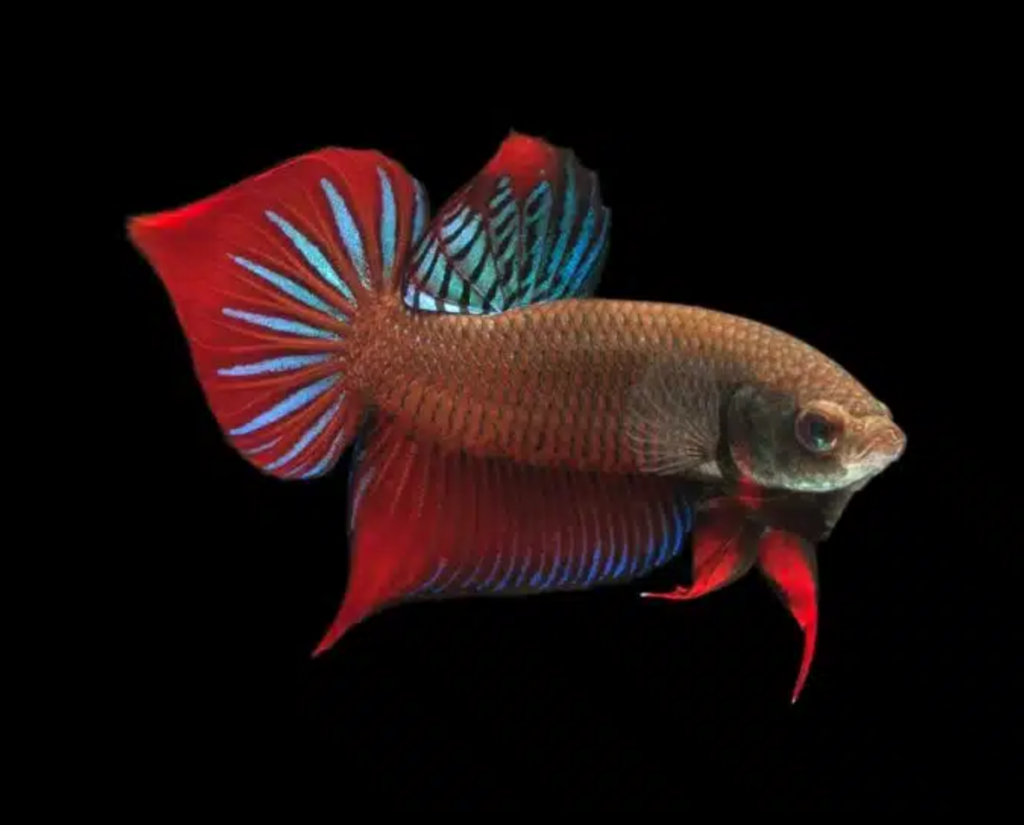
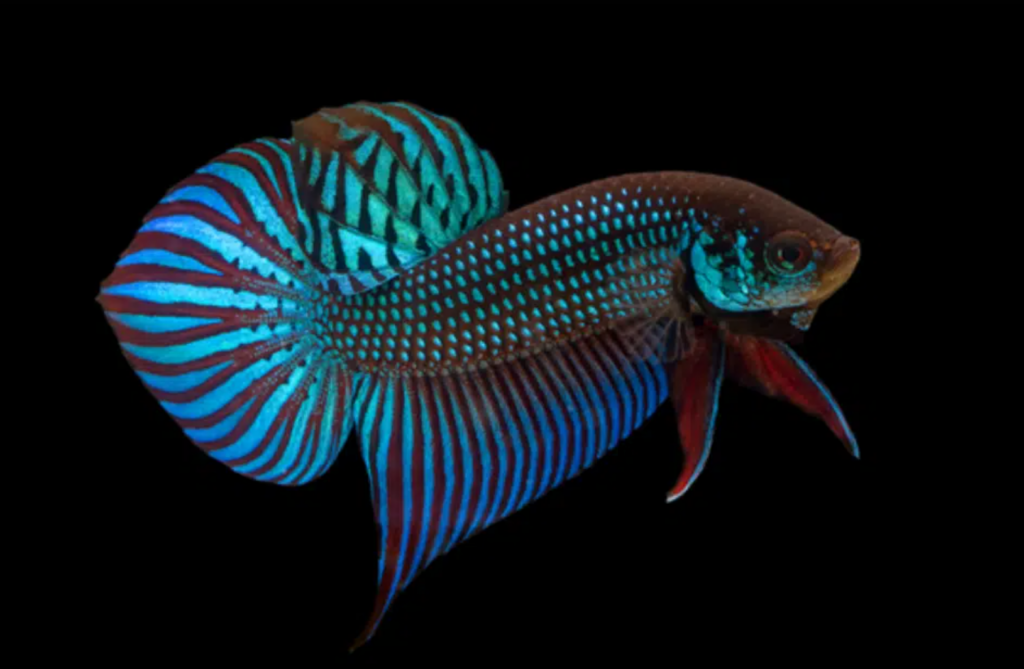
Naturally, there are two types of base colors: Red-Black and Green
Red is the base color and the dominant gene, if the inbreed is duplicated it will show the recessive gene as follows charge.

And green as the basis. If the inbreed is repeated, it will show the recessive genes as follows.

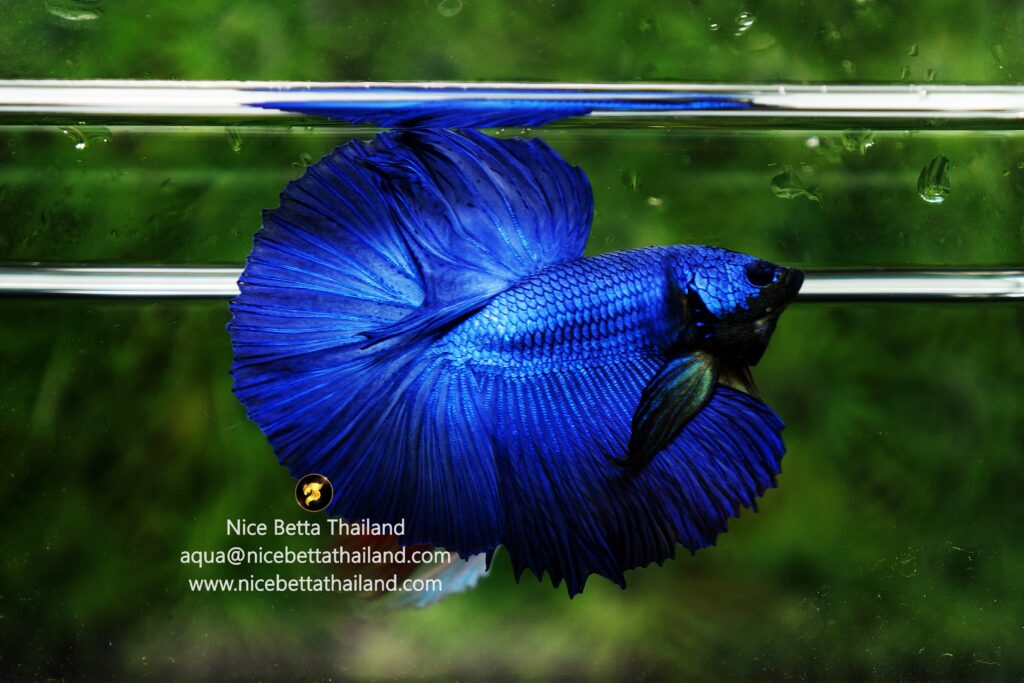
At this point, we know that that blue betta In fact, it is a recessive gene from the former green color itself. Blue betta fish are now bred by breeders to become a stable pedigree color. It is blue without black soot or red on the fins, mainly to meet the market demand.
And as for the the veiltail betta, it is an evolution from these wild bettas starting with the spade tail and changing until it has a longer pointed tail. Also known as Veiltail.
When we understand the nature of fish color preliminary. It will be easier to understand the next content.
History of blue half moon Blue betta fish.
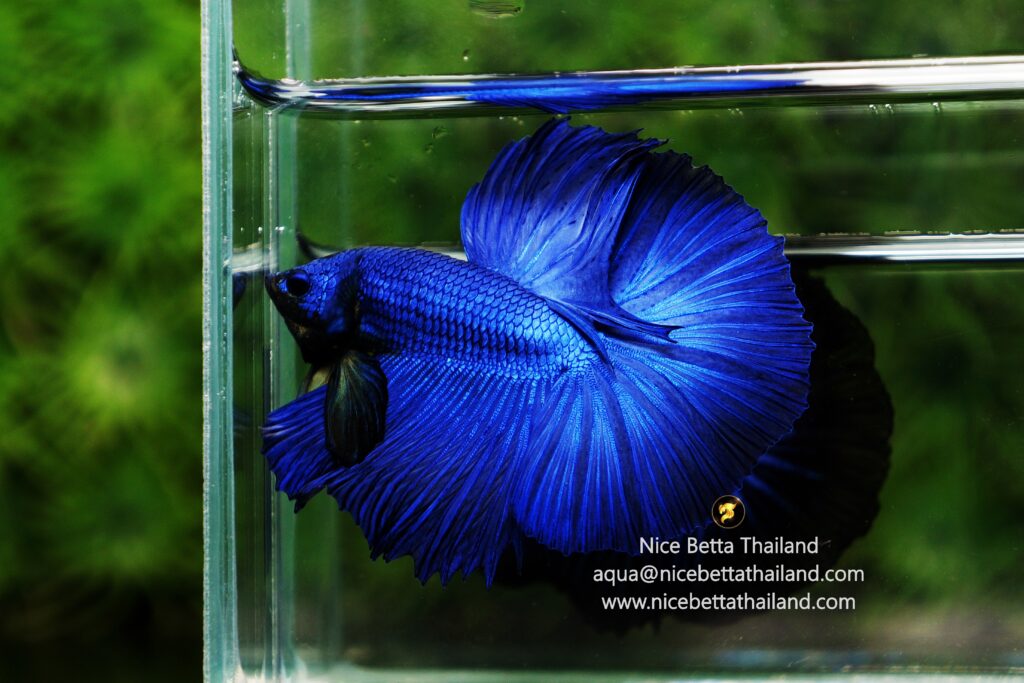
Please read the above article to understand it first. because if you don’t read It will be very difficult to understand the next.
At the same time, Halfmoon is basically not a real betta in the region of Thailand. There is a breeder named Loong Moo who imported the green half moon betta from USA during the year 1999-2000.
and has brought this green halfmoon betta fish to be intertwined with the blue Veiltail betta that has a stable bloodline. which is a real Thai fighting fish together.
and the results Often very disappointed Because it is a young fish that has both green and blue and a little red mixed in the fins. And the tail is mostly Delta Super Delta, which is caused by cross breeding and the imported green color is not stable genetic.
Loong Moo has developed and brought this set of fry in breeder together. By selecting the fry that have many broken tail shaft characteristics similar to Half moon, but not quite Halfmoon because the angle of the tail is lower than 180 degrees.
It has been developed continuously until it is a half moon with the perfect color for us to see until now.
History of blue betta fish summary
The current blue betta is a recessive gene that evolved from the green color in the original wild betta, which originally only had red-black and green colors. Later, in 1999-2000, Uncle Moo, a breeder, brought Green Halfmoon betta fish imported from the United States and crossed them with Blue Veiltail fighting fish, a Thai breed with stable bloodlines, to improve their color and shape. Although the first generation of fry had a mix of green, blue, and red, and had Delta/Super Delta tails, through continuous development and breed selection, he was able to successfully breed the perfect-colored Blue Halfmoon fighting fish known today.
Reference: https://animalverse.social/members/0xa7171ebba801bd10a5ce7a061d6e80c044d0e075/activity/24549/
If our article History of blue betta fish was useful to you You can leaving a 5-star reviews for It’s an encouragement. For us make encourage us in our research. Research information about betta fish for to present useful information further

Also we have group talk about betta fish for sale and share any new tip take care information on Web3 socialFi group

Right now we have betta fish doctor help every bettas lover by top breeder in Thailand to cure or share more tip on Animalverse social
If your bettas fish sick or need tip to treat help or join event prize with AVC Token
Let’s join the group many top breeder will help to answers in betta fish community
More tip :
All of Betta Fish A Guide on Patterns, Color in the world
History and biology of the Red Betta Fish
The most expensive betta fish in the world.

(FAQ) About the history of the blue betta fish
1. What color of betta fish does the Blue Betta Fish originate from?
The current blue betta is a recessive gene that was developed from the green betta, which is the original color of wild bettas.
2. In the past, why did Thai people like to raise betta fish?
Thai people like to raise betta fish for fighting and gambling, and they are also popular ornamental fish traded in the Sampeng area.
3. How expensive were betta fish in the past?
Some fighting fish were worth as much as several years of government salary, even though at that time government officials earned only 20 baht per month.
4. What colors did the first betta fish have?
Originally, fighting fish only came in red, black, and green before the development of new colors like blue.
5. What is a Veiltail Betta?
Veiltail Betta is a betta fish that has evolved from wild fighting fish. It has long, pointed fins and a tail that are characteristic of this species.
6. Are Halfmoon Betta fish native to Thailand?
No, Halfmoon Bettas do not naturally occur in Thailand, but were imported from Germany in 1999–2000.
7. Who developed the Halfmoon betta fish in Thailand?
Uncle Moo is a breeder who crossed the green Halfmoon Betta fish from Germany with the blue Veiltail Betta fish from Thailand to develop a new breed.
8. What problems were encountered during the first breeding?
The resulting fry have a mix of green, blue and red colours and an incomplete tail shape. They are mostly Delta or Super Delta rather than Halfmoon.
9. How did the blue Halfmoon Betta fish we see today come about?
After continuous selection and development by Thai breeders, the Blue Halfmoon Betta has the characteristic 180-degree tail spread, bright colors and perfection as seen today.